


The Inspiring Story of a 70-Year-Old Mother Who Turned Community Forest Rights into a Weapon to Save Trees
Secured the Protec तयtion of Over 50,000 Trees Across 890.03 Acres into the Hands of Villagers
*By Pallove*
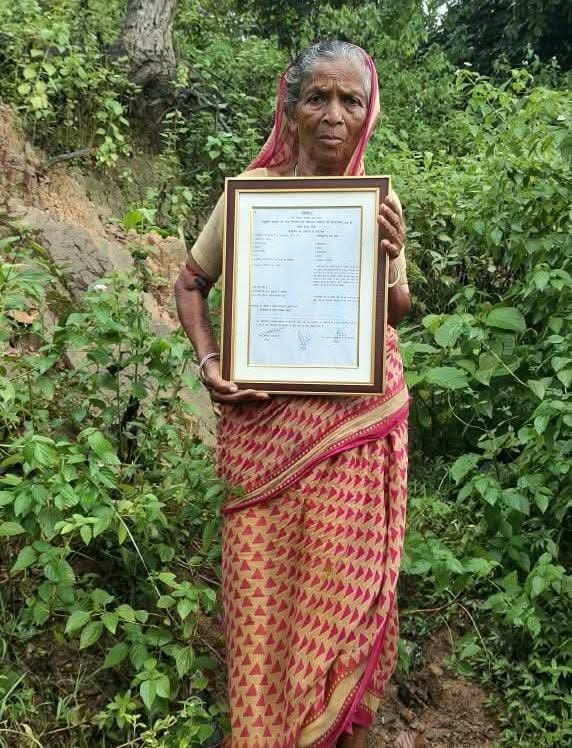
*Godda (jharkhand* ): At the age of 70, when physical strength usually begins to fade, when people resign themselves to depending on their sons and daughters, and when navigating rugged, uneven terrain becomes difficult—at that very age, 70-year-old Lal Muni Dehrin (Paharin) fought like Goddess Durga to secure forest land rights for her fellow villagers. Shrinking the sheer height of the hills before her resolve, Lal Muni stepped down from the highlands to persistently tread the long distances between the Circle Office, the Forest Department, and the Deputy Commissioner’s Office.
At times, she felt confident about securing Community Forest Rights for the vast woodland adjacent to the village; at other times, legal complexities left her disheartened. But Lal Muni firmly believed: "If the forest does not survive, neither will we." The forest mafia had begun luring the local Paharia people with alcohol and money to fell ancient trees. The inner forest was turning hollow and barren. If this continued, the very existence of the Paharia tribe—who dwell among these hills and forests—would be imperiled. Deeply concerned for the future of her children and grandchildren, Lal Muni fought valiantly and rested only after securing Community Forest Rights over 890.03 acres of forest land on August 9, 2026, marking International Day of the World’s Indigenous Peoples.
*What Are Community Forest Rights?*
Under the Forest Rights Act (FRA) of 2006, Community Forest Rights grant the Gram Sabha and local communities the legal authority to use, protect, and manage their traditional forest areas. The Government of Jharkhand is implementing this through a dedicated drive via the Abua Bir Abua Dishom Campaign and the Jhar-FRA digital platform. This is not an individual land title; rather, it represents the collective right of the entire village Gram Sabha.
Key benefits to the villagers include full ownership over minor forest produce—such as gathering, collecting, processing, and selling items like Mahua, Kendu leaves, Sal (Sakhuwa) seeds, Lac, Karanj, honey, gum, and medicinal herbs at rates determined by the Gram Sabha. The Forest Department cannot interfere or impose restrictions on these activities.
*Who is Lal Muni Dehrin (Paharin)?*
Lal Muni Paharin is the village head (Gram Pradhan) of Sindrijola village, located in the Susni Panchayat of Sundarpahari block. Her enduring conviction is that from childhood to old age, their lives have unfolded within these woods. To them, the forest is not merely a collection of trees; it is like a mother. Just as one cares for parents and in-laws, or nurtures sons and daughters, they have always protected these trees as their own.
When timber syndicates began exploiting local villagers with inducements to cut down timber, Lal Muni realized that securing Community Forest Rights was the only way to save the forest from devastation. She organized a Forest Rights Committee comprising 15 village members, ensuring representation for 5 women. They submitted Form (B) for traditional community rights and Form (C) for forest resource conservation and management rights. She pursued the case relentlessly from the block office to the district administration, ultimately securing communal ownership over more than 890 acres of forest land for the village.
*The Impact and Benefits*
Lal Muni Paharin notes that following the recognition of Community Forest Rights, villagers do not permit a single tree to be cut. Today, more than 50,000 trees are directly monitored and protected by the Gram Sabha. Villagers readily obtain dry firewood and grazing fodder for their livestock.
Furthermore, the community has secured the legal right to protect sacred cultural landmarks inside the forest, including Jaher Than, Sarna Sthal, Sasandiri (burial grounds), and traditional places of worship. If anyone attempts unauthorized logging, the Gram Sabha imposes strict penalties. By vesting the forest title directly in the community, illegal deforestation across this land has come to a virtual standstill.
The Inspiring Story of a 70-Year-Old Mother Who Turned Community Forest Rights into a Weapon to Save Trees